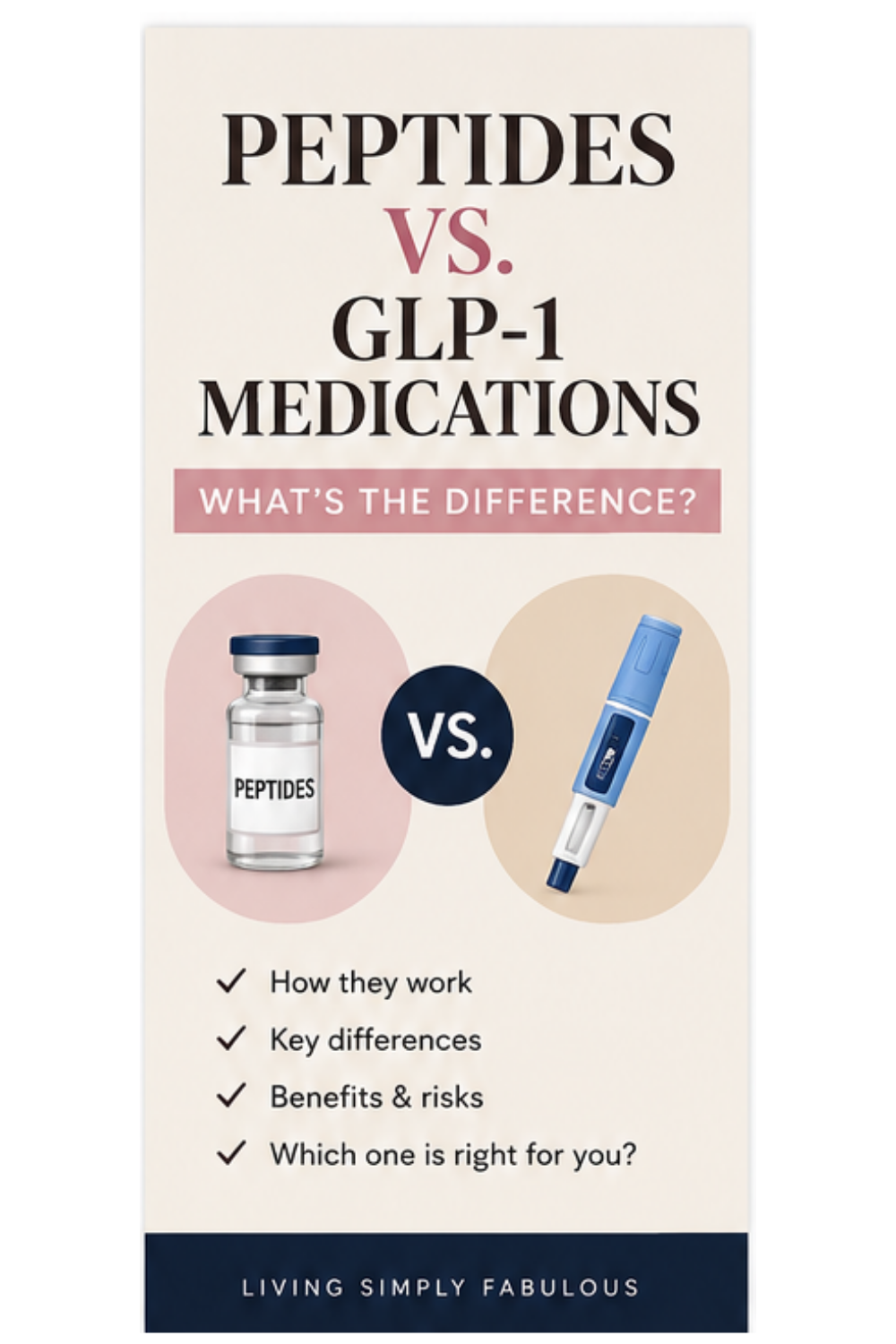
Peptides 101: A Beginner’s Guide to Weight Loss, Energy, Recovery, Skin & More

Peptides are everywhere right now.
Weight loss? There’s a peptide for that.
Recovery? Somebody is talking about a peptide.
Better skin, more energy, improved sleep, less inflammation, sharper thinking, healthier aging?
Yep. Peptides are being discussed for all of that too.
And if you’ve fallen down the peptide rabbit hole on TikTok, YouTube, Reddit, or one of those late-night Google searches, you already know things can get confusing fast.
So I decided to put together the beginner’s guide I wish existed when I first started researching them.
First, the disclaimer.
Before We Go Any Further: I Am Not a Doctor
I am not a physician, pharmacist, nurse practitioner, endocrinologist, or peptide specialist.
I don’t even play one on TV.
This article is for education and research purposes only. I am taking information from published studies, FDA documents, clinical trials, and other available research and putting it into regular-people language.
This is not a dosing guide, an injection tutorial, or a recommendation that you purchase or use any particular peptide.
And there is another distinction people need to understand:
Not all peptides are FDA-approved—but not all peptides are unapproved either.
As of August 2026, tirzepatide is FDA-approved for several indications, tesamorelin has an FDA-approved use, and elamipretide—often called SS-31—received FDA approval in 2025 for a rare mitochondrial disorder. Many of the other peptides commonly sold through wellness clinics and online peptide companies remain investigational or unapproved for human use.
Also remember that an FDA-approved active ingredient and a compounded version of that ingredient are not the same thing. Compounded medications themselves are not FDA-approved, meaning the FDA does not review each compounded product for safety, effectiveness or manufacturing quality before it is sold.
With that out of the way, let’s talk peptides.
What Exactly Is a Peptide?
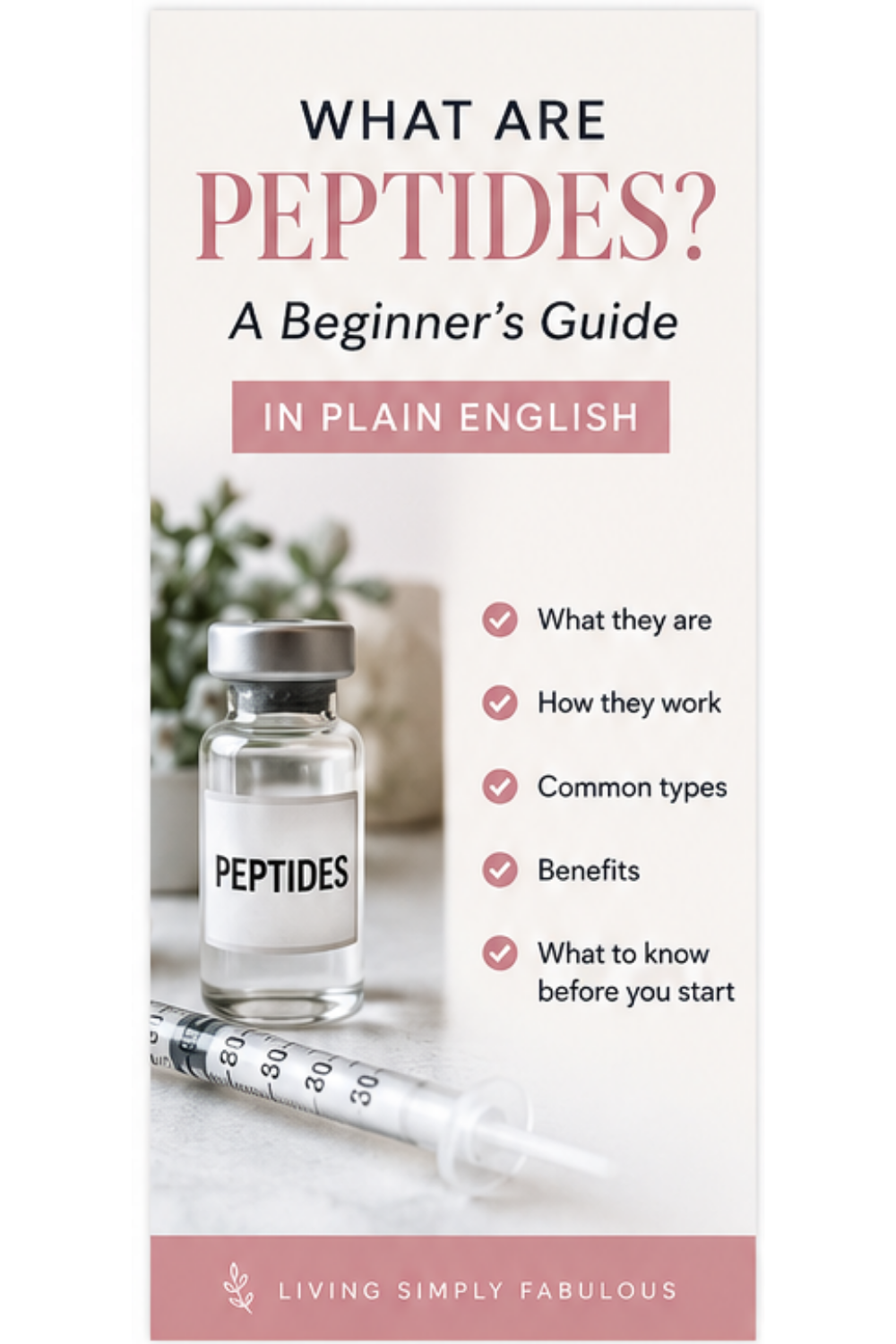
Peptides are essentially short chains of amino acids—the same building blocks that make up proteins.
Our bodies naturally produce many peptides, which act like messengers telling different cells and systems what to do.
Depending on the peptide, those signals can influence things such as:
- appetite and metabolism
- hormone release
- inflammation
- tissue repair
- immune activity
- skin remodeling
- glucose regulation
- mitochondrial function
Researchers have figured out how to create or modify certain peptides so those biological signals can potentially be used therapeutically.
And THAT is where the peptide world gets interesting.
But interesting does not automatically mean proven.
I like to separate peptides into three buckets:
Green light: FDA-approved medication being used for its approved purpose.
Yellow light: A peptide with legitimate research behind it but being used off-label or for an investigational purpose.
Red light: A research peptide with little or no meaningful human safety data being marketed like researchers have already figured everything out.
That last group is where we need to use some common sense.
GOAL #1: Weight Loss and Metabolic Health
Tirzepatide
You may know tirzepatide by the brand names Mounjaro or Zepbound.
Tirzepatide activates both GIP and GLP-1 receptors. Those signals affect appetite, food intake, insulin regulation, and metabolism.
In major clinical trials, tirzepatide produced substantial weight loss in adults with obesity or overweight.
Zepbound is FDA-approved for chronic weight management in qualifying adults and is also approved to treat moderate-to-severe obstructive sleep apnea in adults with obesity.
Why people use it
Tirzepatide may help with:
- decreased appetite
- greater satiety
- significant weight reduction
- improved glucose regulation
- improved metabolic health
This isn’t an obscure “research peptide.” There are large human clinical trials and FDA-approved indications. I have used Mounjaro and a tirzepatide compound and have lost weight. My side effects have been minimal.
That doesn’t mean it’s appropriate for everyone, by the way, or side-effect-free. It means we actually have considerably more evidence to work with.

Retatrutide
Retatrutide is probably one of the most talked-about next-generation weight-loss drugs.
Unlike tirzepatide, which targets two hormone receptors, retatrutide activates three:
GLP-1 + GIP + glucagon.
In a Phase 2 clinical trial, people receiving retatrutide experienced substantial weight reduction over 48 weeks.
Sounds impressive.
But here’s the part social media occasionally forgets to mention:
Retatrutide remains investigational.
It is still being studied in large clinical trials and is not currently an FDA-approved medication.
The FDA has specifically taken action against companies selling retatrutide as though it were an approved medication.
Why researchers are interested in it
Potential benefits being studied include:
- substantial weight reduction
- appetite control
- improved metabolic health
- possible reductions in visceral and liver fat
- cardiovascular outcomes
This is one to watch, not one I would treat like an established DIY medication. I have always stated that I will transition to Reta once I max out tirzepatide.
Tesamorelin
Tesamorelin is frequently discussed in the peptide community for its effects on visceral abdominal fat.
And here’s an important distinction.
Tesamorelin really is FDA-approved—but not as a general belly-fat or weight-loss medication.
It is approved to reduce excess abdominal fat in adults with HIV-associated lipodystrophy.
Tesamorelin mimics growth-hormone-releasing hormone, stimulating the pituitary to increase the body’s own production of growth hormone.
What it may influence
- visceral abdominal fat
- growth hormone signaling
- IGF-1 levels
- body composition
The reality check
Having stubborn belly fat does not automatically make someone an appropriate candidate for tesamorelin.
Its FDA-approved indication is very specific.
MOTS-c
MOTS-c is one of the more fascinating peptides on my list.
It is a mitochondrial-derived peptide, meaning it is associated with the tiny structures inside our cells that produce energy.
Preclinical research suggests MOTS-c may influence glucose metabolism, insulin sensitivity, muscle metabolism, and metabolic homeostasis.
Human research has also shown associations between naturally occurring MOTS-c, exercise, and metabolic health.
But injecting synthetic MOTS-c is an entirely different question.
The FDA states that it has not identified adequate human exposure data for compounded MOTS-c and does not have enough information to determine its safety when administered to humans.
Why people are interested in it
Research is exploring possible effects involving:
- insulin sensitivity
- glucose metabolism
- mitochondrial health
- exercise capacity
- metabolic health
- healthy aging
Interesting science does not yet equal established therapy.
GOAL #2: Energy and Mitochondrial Health
SS-31 / Elamipretide
This one needs an update because peptide information online becomes outdated quickly.
SS-31 is also known as elamipretide.
It targets mitochondrial function.
In September 2025, the FDA granted accelerated approval to elamipretide under the brand name Forzinity to improve muscle strength in adults and children weighing at least 30 kilograms who have Barth syndrome, a rare mitochondrial disease.
So yes—SS-31/elamipretide now has an FDA-approved medical use.
That does NOT mean it has been FDA-approved as an everyday energy booster, longevity treatment, sleep aid or anti-aging medication.
Why researchers are interested in it
Because it acts on mitochondria, researchers have investigated potential effects involving:
- mitochondrial function
- cellular energy
- muscle function
- certain mitochondrial diseases
GOAL #3: Sleep, Recovery and Growth Hormone Signaling
Several peptides marketed for “recovery” work by influencing growth hormone pathways.
That does not make them interchangeable.
Sermorelin
Sermorelin mimics growth-hormone-releasing hormone and signals the pituitary gland to release growth hormone.
Sermorelin was once FDA-approved as Geref for certain pediatric growth-hormone-related indications, although that commercial product was later discontinued. There are no currently FDA-approved growth-hormone secretagogues for treating adult growth hormone deficiency.
Today you may see sermorelin promoted for:
- recovery
- body composition
- sleep quality
- age-related changes in growth hormone
Those adult wellness uses should not be confused with an FDA-approved anti-aging indication.
Ipamorelin
Ipamorelin is another growth-hormone secretagogue.
You’ll often hear it mentioned by people interested in:
- exercise recovery
- muscle preservation
- sleep
- body composition
- growth hormone optimization
But human safety data are limited.
The FDA has specifically raised concerns regarding compounded ipamorelin, including inadequate safety information for several routes of administration.
And this is exactly why “everybody at my gym uses it” is not a clinical trial.
GOAL #4: Joints, Muscles and Tissue Repair
Now we get into two of the biggest names in the peptide world.
BPC-157
BPC-157 is frequently described online as a healing or recovery peptide.
Animal and laboratory research has generated interest in its possible effects on tissue healing, inflammation, tendons and the gastrointestinal tract.
But here’s the big problem:
The quality of human evidence does not match the enormous claims you’ll see online.
FDA says it has limited safety information regarding compounded BPC-157 and cannot determine whether it may cause harm when administered to humans through proposed routes.
People commonly investigate it for
- tendon injuries
- joint problems
- muscle recovery
- wound healing
- gastrointestinal repair
TB-500
TB-500 is generally described as a fragment associated with thymosin beta-4.
It is marketed heavily for:
- recovery
- tissue repair
- flexibility
- muscle injury
- tendon and ligament healing
But FDA reports that it has not identified adequate human exposure data for TB-500 and lacks enough information to determine its safety.
This is another case where the marketing is several exits ahead of the science.
No, Hugh Jackman did not personally approve this. The nickname comes from Wolverine’s fictional ability to heal ridiculously fast. (Get it??? Lol.)
The term generally refers to combining:
BPC-157 + TB-500
The combination is marketed primarily for injury recovery and tissue repair, with claims involving tendons, ligaments, muscles, joints and wound healing. The theory is that the two compounds may affect different aspects of the healing process, which is why they are often paired together instead of used individually.
What About the Famous “Glow Stack”?
You’ll sometimes see:
BPC-157 + TB-500 + GHK-Cu
marketed informally as a “Glow Stack.”
And sometimes:
BPC-157 + TB-500 + GHK-Cu + KPV
gets marketed as a larger “Klow” or skin/recovery stack.
Here’s where I pump the brakes.
These are not standardized FDA-approved medical protocols.
Combining several experimental substances also makes it harder to determine which substance caused a benefit—or a problem.
My beginner rule is simple:
Do not assume that four experimental compounds become safer because somebody gave the combination a cute name.
GOAL #5: Skin, Hair and That Grown-Woman Glow
GHK-Cu
Now THIS peptide is interesting for skincare.
GHK is a naturally occurring peptide that binds copper. Research involving GHK-Cu has explored tissue remodeling, collagen-related processes, wound healing and skin regeneration.
Topical GHK-Cu has a much longer history in skincare than injectable GHK-Cu.
And that distinction matters.
FDA specifically notes that injectable GHK-Cu has limited human safety data and may carry immunogenicity concerns.
Non-injectable GHK-Cu remains under FDA evaluation in the compounding context.
Why people like it
Potential cosmetic applications include:
- skin remodeling
- collagen support
- wound healing
- improving the appearance of aging skin
- possible hair-related applications
KPV
KPV is usually promoted for its possible anti-inflammatory properties.
You’ll see it discussed for:
- skin irritation
- inflammatory skin conditions
- gut inflammation
- wound recovery
Most of the excitement comes from laboratory and preclinical research.
FDA states that it has not identified human exposure data for KPV drug products and lacks enough information to establish its safety.
The Advanced Peptide Category
These are the ones I would put firmly in the “interesting research, proceed with serious caution” column.
Thymosin Alpha-1
This peptide has been studied for its effects on the immune system, including immune-cell activity and infectious disease or cancer-related applications. Human clinical trials exist in several disease areas.
However, compounded thymosin alpha-1 is not an FDA-approved general immune booster, and FDA says available safety information is insufficient to fully characterize its risks in compounded products.
Research interest: immune modulation.
Epitalon
Epitalon gets marketed heavily in longevity circles.
Claims frequently involve:
- longevity
- sleep
- circadian rhythms
- anti-aging
- cellular aging
The evidence is nowhere near strong enough to treat those claims as established facts.
In July 2026, FDA reviewers concluded that available information was insufficient to support the safety and effectiveness of compounded Epitalon and recommended against including it on the relevant compounding bulk-drug list.
My category: extremely experimental.
Semax
Semax is usually discussed as a nootropic peptide for:
- attention
- memory
- mental performance
- neurological recovery
- cognitive function
But FDA’s 2026 review found insufficient evidence supporting proposed medical uses and inadequate safety characterization for compounded Semax.
My category: experimental.
Dihexa
Dihexa is another substance that gets mentioned in biohacking and cognition circles.
You’ll see claims involving learning, memory and neuroplasticity.
But FDA says it has not identified human exposure data for Dihexa acetate drug products and lacks enough information to know whether it may cause harm in humans.
That’s about as red a research flag as a beginner needs.
My category: very experimental.
Selank
Selank is commonly marketed as a calming or anxiety-related peptide.
People talk about:
- relaxation
- stress
- anxiety
- mood
- mental clarity
However, FDA says adequate safety information for human administration is lacking.
That doesn’t prove Selank does nothing.
It means we don’t have enough reliable evidence to treat internet claims as established medicine.
So How Should a Beginner Approach Peptides?
If you’re considering peptide therapy, this is the roadmap I would use.
Step 1: Start With the Problem, Not the Peptide
Don’t start with:
“Everybody is taking BPC-157. Maybe I should too.”
Start with:
“My knee has hurt for six months. Why?”
Or:
“I’m gaining abdominal weight even though my habits haven’t changed.”
Or:
“I’m exhausted all the time.”
Or:
“I’m struggling to lose weight.”
Figure out what you’re actually trying to solve first.
Because fatigue could be sleep deprivation, anemia, thyroid disease, medication side effects, menopause, nutritional issues or seventeen other things.
You don’t want to throw a peptide at something when the real issue requires different treatment.
Step 2: Look at the Evidence Ladder
When several options exist, I would rank them like this:
First choice: FDA-approved treatment supported by good human research.
Second: An established medication being used off-label by a knowledgeable licensed clinician.
Third: Investigational treatment available through a legitimate clinical trial.
Wayyyyy down the road:
“A man on TikTok sells it in a vial marked FOR RESEARCH PURPOSES ONLY.”
No ma’am.
Research-use-only peptides are not automatically pharmaceutical-grade human medications.
Step 3: Find a Clinician Who Actually Understands the Therapy
Not somebody whose entire medical evaluation consists of:
“Which package would you like—the $299 Silver Stack or the $499 Platinum Goddess Stack?”
You want someone who asks about:
- your medical history
- current medications
- supplements
- allergies
- blood pressure
- glucose control
- pregnancy status when relevant
- endocrine history
- cancer history
- treatment goals
- appropriate laboratory monitoring
Depending on the treatment being considered, a clinician may recommend baseline and follow-up laboratory testing.
Step 4: Know Exactly Where Your Medication Comes From
This matters tremendously with injectable products.
FDA has repeatedly warned about unapproved products being marketed as alternatives to approved GLP-1 medications and about quality concerns involving improperly compounded drugs.
I would want to know:
Who prescribed it?
Who compounded or manufactured it?
Is that pharmacy appropriately licensed?
What exactly is in the vial?
What is the concentration?
How was sterility verified?
How should it be stored?
What side effects require medical attention?
If nobody can give you straight answers to those questions, that would be my cue to exit stage left.
Step 5: Don’t Turn Yourself Into a Science Fair Project
This may be my biggest beginner tip.
If you start five things simultaneously and suddenly feel wonderful—or horrible—you won’t know what caused it.
Peptide communities love stacks.
Your body does not care how trendy the stack is.
The more compounds you introduce, particularly experimental ones, the more variables you’ve created.
There is nothing wrong with moving slowly.
Step 6: Track What’s Actually Happening
If you’re using a legitimate peptide medication under medical supervision, keep records.
Depending on your goal, track things such as:
- weight
- waist circumference
- blood pressure
- appetite
- sleep
- energy
- bowel habits
- exercise performance
- pain
- skin changes
- side effects
- relevant laboratory values
That gives you and your clinician objective information.
“I think I feel better” is useful.
“My waist decreased three inches, my A1C improved, my blood pressure stayed stable and I’m having no significant side effects” is much more useful.
Step 7: Know When to Stop Playing Around
Call your healthcare provider if you develop symptoms that concern you.
And severe allergic symptoms, breathing difficulty, chest pain, severe or persistent abdominal pain, uncontrolled vomiting, fainting, neurological symptoms or signs of a serious injection-site infection aren’t situations where I would be asking Facebook what everybody thinks.
Get medical care.
My Beginner Peptide Roadmap at a Glance
Weight loss
Best-established option from this list: Tirzepatide when medically appropriate.
Interesting but still investigational: Retatrutide.
Specialized medication: Tesamorelin for its approved HIV-lipodystrophy indication.
Experimental: MOTS-c.
Energy / mitochondria
SS-31 / elamipretide: Legitimate FDA-approved drug for Barth syndrome, but general “energy optimization” is not its approved use.
MOTS-c: Experimental.
Recovery / growth-hormone signaling
Sermorelin: Previously approved for a specific pediatric indication; adult wellness use is different.
Ipamorelin: Experimental with limited safety data.
Joints / tissue recovery
BPC-157: Experimental.
TB-500: Experimental.
Skin / beauty
Topical GHK-Cu: Interesting cosmetic research.
Injectable GHK-Cu: Much less established.
KPV: Experimental.
Immune function
Thymosin Alpha-1: Genuine research interest, but not an FDA-approved general immune booster.
Longevity
Epitalon: Very experimental.
Cognition
Semax: Experimental.
Dihexa: Extremely limited human safety evidence.
Anxiety / calming
Selank: Experimental.
The Bottom Line
I understand why people are fascinated by peptides.
I am too.
Some of this research could eventually change how we treat obesity, metabolic disease, tissue injury, mitochondrial disorders and other health conditions.
But the peptide world currently mixes real medicine, promising science, early-stage research and internet hype in the same blender.
That’s why doing your homework matters.
Don’t assume something is safe because it’s called a peptide.
Don’t assume it’s FDA-approved because a clinic prescribes it.
Don’t assume it isn’t FDA-approved because someone online calls it a “research peptide.”
And definitely don’t assume that because one peptide may be helpful, combining four of them will make you four times fabulous.
Unfortunately, biology does not respect girl math.
Research the compound.
Understand what evidence actually exists.
Know whether you’re dealing with an approved medication, an off-label treatment or an experimental substance.
Work with an appropriately licensed healthcare professional.
And then make an informed grown-person decision about what’s right for your body.
Because Living Simply Fabulous isn’t about chasing every wellness trend that hits the internet.
It’s about knowing enough to decide which ones deserve your attention—and which ones deserve a hard pass.
Medical Disclaimer: This article is provided for general educational and informational purposes only and does not constitute medical advice, diagnosis or treatment. Peptide therapies can have side effects, contraindications, drug interactions and quality or sterility concerns. Some compounds discussed in this article are investigational and are not FDA-approved for human use or for the wellness purposes described. Always consult a qualified healthcare professional before starting, stopping or changing any medication, compounded medication, peptide, supplement or medical treatment.